About
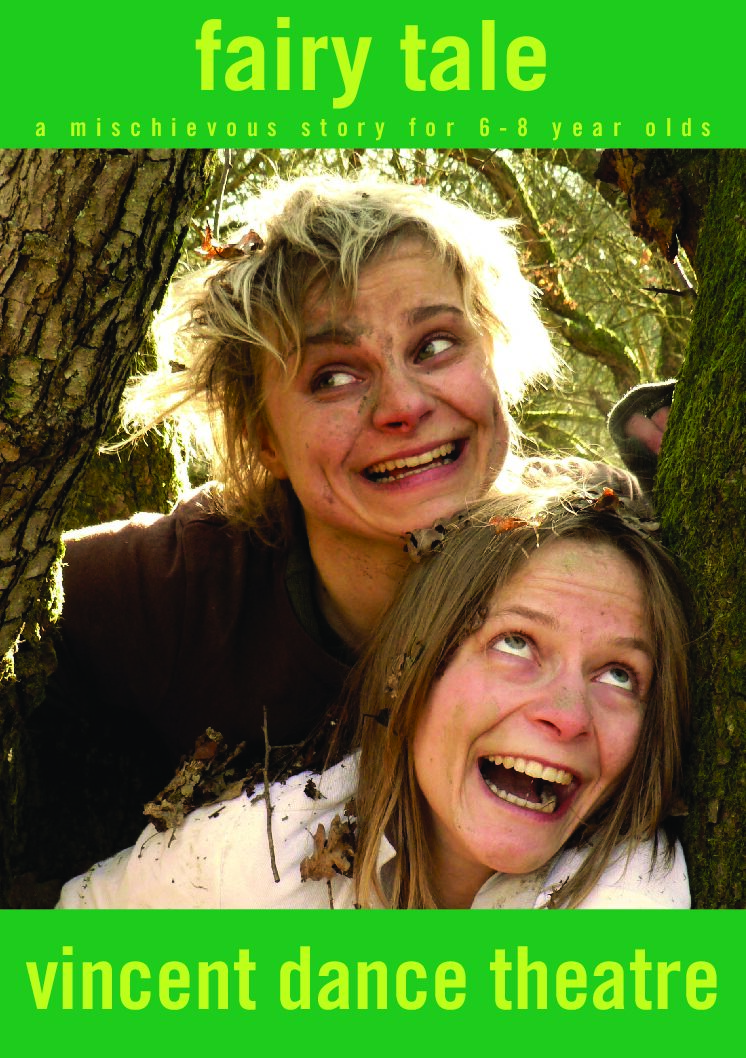
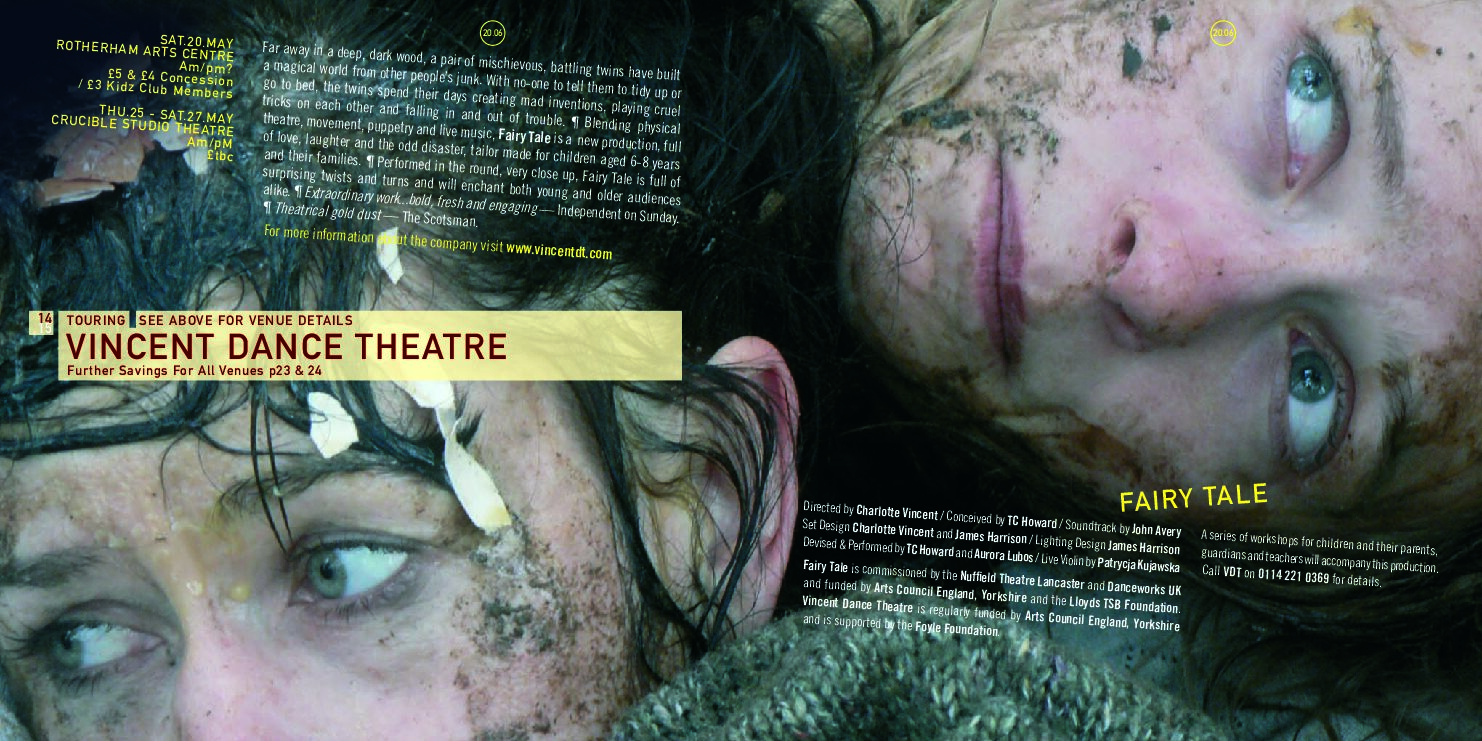
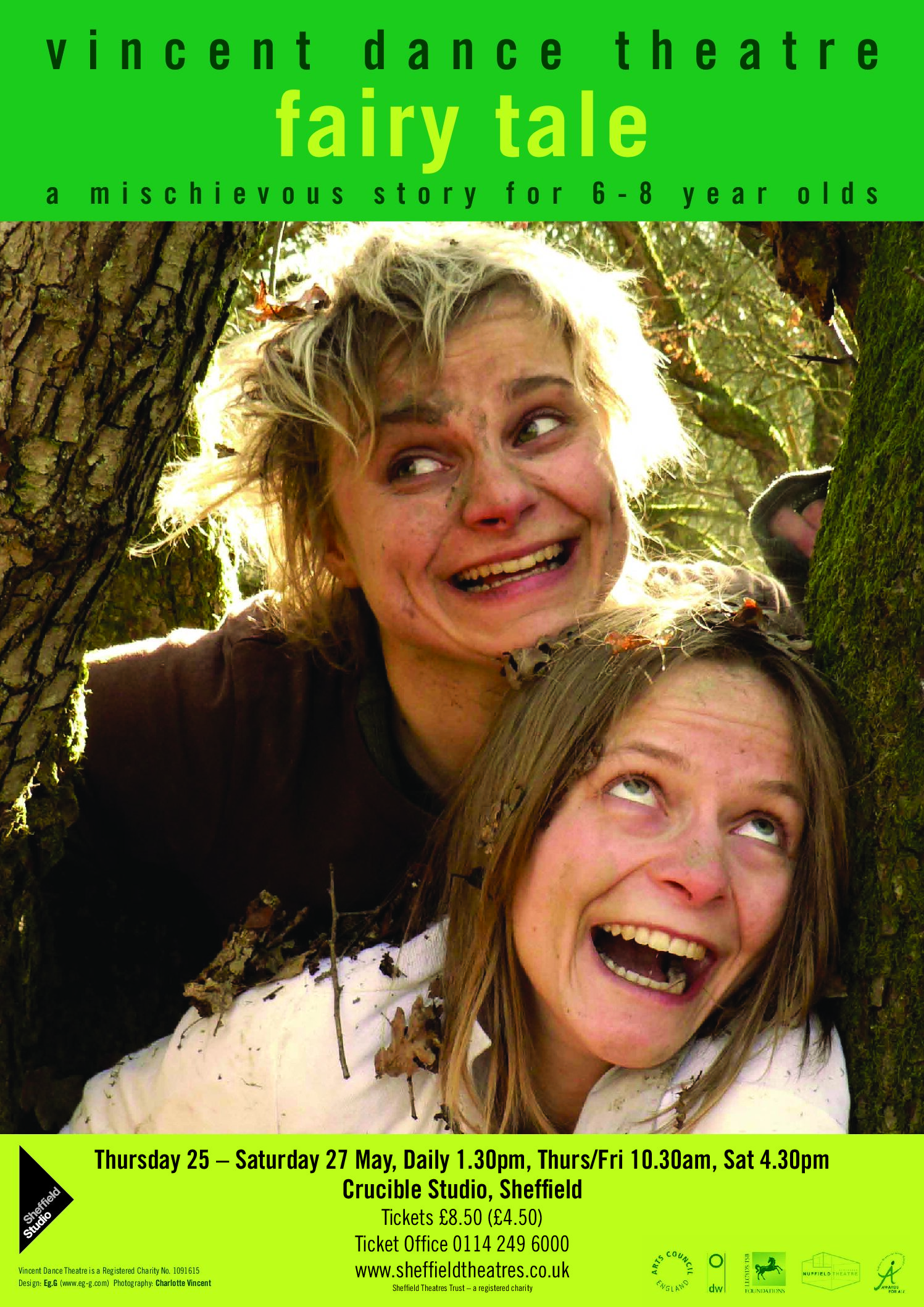
Far away in a deep, dark wood, a pair of mischievous, battling sisters have created a magical world from other people’s junk. With no-one to tell them to tidy up or go to bed, the sisters spend their days and nights building mad inventions, playing cruel tricks on each other and falling in and out of trouble.
Blending physical theatre, movement and puppetry, Fairy Tale is a dark and delightful production, full of love, laughter and the odd disaster, tailor made for children aged 6-8 years and their families. Full of surprising twists and turns, Fairy Tale enchants both young and older audiences alike.
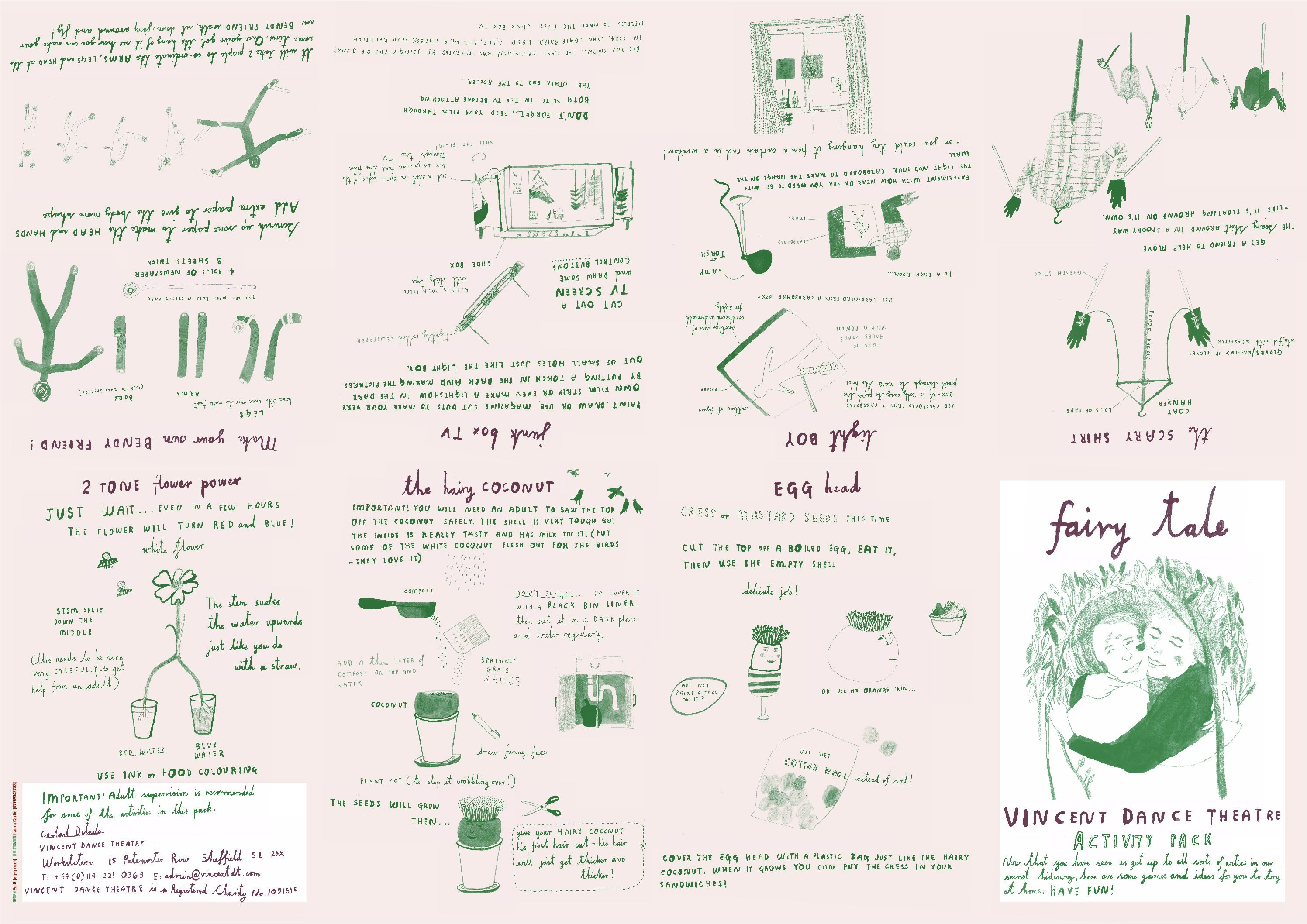
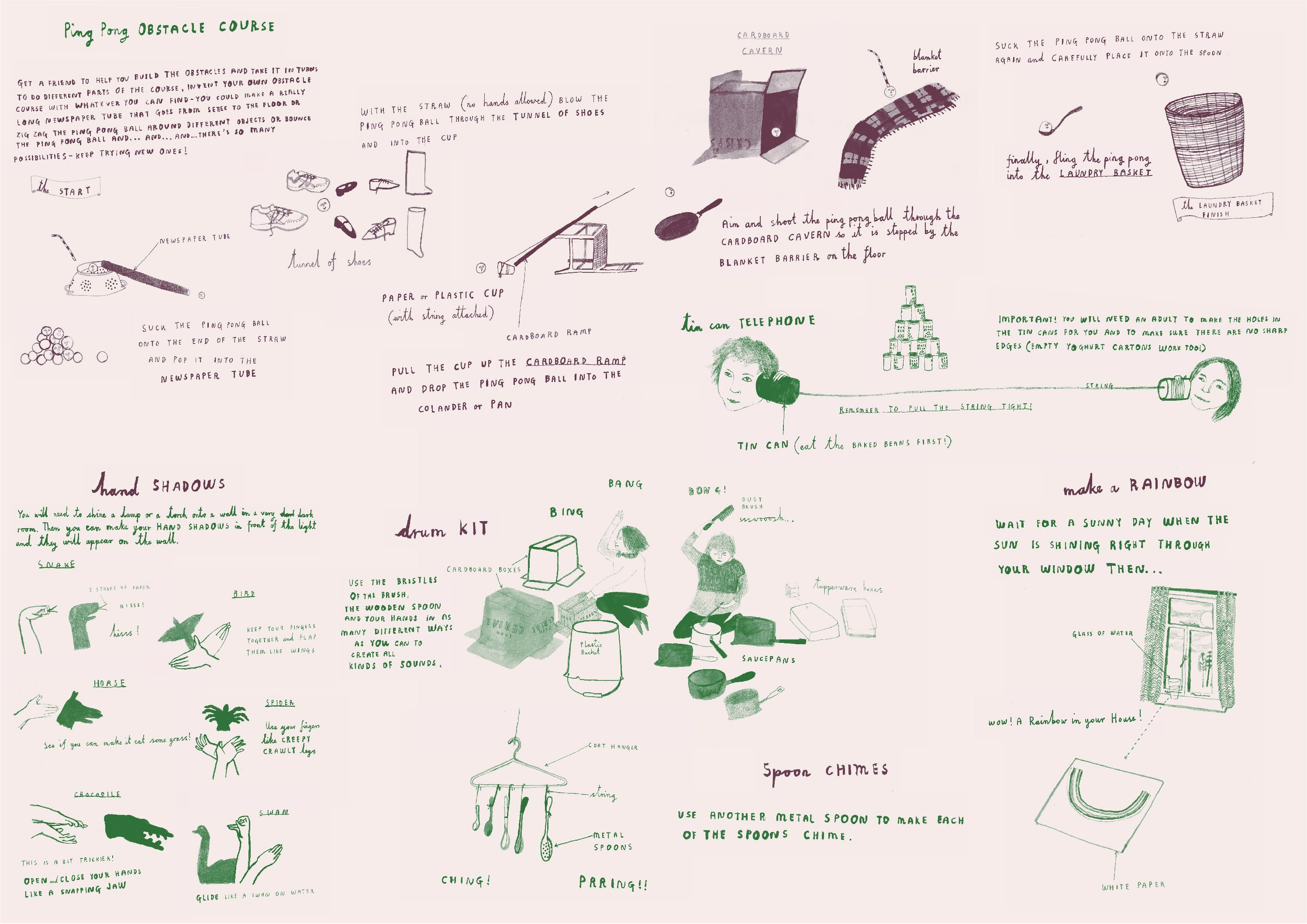
A series of workshops for children and their parents, guardians and teachers accompanied this production.
Fairy Tale was commissioned by the Nuffield Theatre Lancaster and Danceworks UK, funded by Arts Council England, Yorkshire Lloyds TSB Foundation for England and Wales and Awards for All and supported by the Foyle Foundation.
Director’s Notes
Introduction to Fairy Tale
By Charlotte Vincent
Opowiedz mi ta historie….
Dawno, downo temu…Once upon a time …dwie siostry….two sisters ….mieszkaly daleko, daleko stad…. lived in a place far, far away,
Where there are pillows on the bed, poduszki
Where shoes fit your feet, tak buty
Where there are cakes, ciasto ha, ha ha…
Where there are cows, hmmmyy
Where the shadows are friendly, cienie
Where there are red cherries that fall from the trees, and you step on them and you squash them, and the juice gets stuck between your toes and it feels like jam!
Where…. there is a river you can swim in, … rzeka
Where you can run for miles, and miles and miles,
Where there is always someone to look after you,
Where you always have company,
Where you don’t have to worry about anything,
Where the stars shine brightly in the sky,
And the moon looks over us as we sleep.
Vincent Dance Theatre’s Associate Artist TC Howard and I discussed the concepts for Fairy Tale following the making of Punch Drunk in 2004. Drawing heavily on TC’s practice as a dancer whose teaching practice spans 20 years FAIRY TALE was designed to consolidate and develop TC’s experience leading multiple projects with young people as Ludus Dance Company’s education officer, running workshops with street children in third world countries whilst working with the David Glass Ensemble as well as capitalise on her unique delivery of large and small scale intergenerational participation dance projects including Dansopolis and Bridlington Waltz.
The foundation of this new work was the exploration of ‘play’ and the strong, comical relationship that existed between TC and Polish performer Aurora Lubos in VDT’s 2004 production Punch Drunk. Described as ‘tiny, dynamic battling elves’ in one press review, TC and Aurora developed a twin attachment with each other that is innocent, mischievous and revels in a kind of fierce rivalry. The development and creation of Fairy Tale aimed to delve further into this relationship through improvisation and play, and initially involved a third adversary figure to shake things up between them.
To play is to unleash an immediacy of an experience whilst allowing a safe passage back to the known order of things. Play is always improvisational and challenges embedded ways of thinking, making us act in new and surprising ways. Children enjoy repetition, exploring the victories, triumphs and anxieties over and over again with total immersion and intensity when they play, and through play gain an understanding and possession of themselves and their world. Children (and actors) often play in ways that are frightening to them in order to summon up and control the things that disturb them most. (Andrew Quick : Not Even A Game Anymore; The Theatre of Forced Entertainment, edited by Judith Helmer and Florian Malzacher).
Research and development took place for two weeks in Sheffield in April 2005. The full production was created over 4 weeks in April 2006 at Sheffield Independent Film by Patrycja Kujawska and Aurora Lubos with a production week at the Nuffield Theatre, Lancaster. Fairy Tale premiered on 5th May 2006 at the Nuffield Theatre, Lancaster, co-directed by TC Howard and Charlotte VIncent.
Credits
Co-directed by
Charlotte Vincent
Artistic Director & Chief Executive (She/Her)
Charlotte formed Vincent Dance Theatre (VDT) in 1994 and has directed all the company’s collaborative work to date, on stage and on film. Vincent has also designed the work since 2005 and performed with the company until 2002. Vincent’s distinctive, contemporary choreography ‘stages ideas’ and embeds her own and her collaborators’ lived experience within the work, raising awareness of personal and political issues, breaking down the barriers between professional and non-professional performers and in VDT’s film installation and engagement spaces, between audience and participant.
Vincent is recognised as a sector leader in movement based socially engaged creative practice and creative health, particularly around her work with care-experienced young people and women at risk, championing gender equality and advocating for best practice to support parents and carers working in the performing arts. Her pioneering work on film ensired VDT were ‘covid ready and able to work through Covid and consequently allows Vincent’s work to be purposefully ‘applied’ in non-arts settings as well within conventional arts venues and settings.
Charlotte is an experienced speaker, lecturer and Mentor, working with early and mid-career artists to develop their creative practice and production work. Vincent has also worked as a director, dramaturg, and facilitator for other artists and companies, most notably Two Destination Language (Near Gone, winner Total Theatre Awards for Innovation and Experimentation 2014), Keira Martin (Here Comes Trouble Sadlers Wells Wild Card and Good Blood) and facilitating early R&D for Sue MacLaine’s Can I Start Again Please (2013).
In the past, Vincent has performed and collaborated with Professor Liz Aggiss as V&A Artefacts, curated an inaugural 4-week festival of experimental performance practice, Juncture at Yorkshire Dance in Leeds and co-hosted The Table, a forum to nurture dialogue across disciplines between established female artists with Dr Claire Macdonald. Charlotte sat on the Artists Advisory Group at Yorkshire Dance for several years and Steering Group for Dance UK’s National Choreographic Conference in 2013. Most recently she has been a driving force behind the development of the London Road Network in Brighton, a collaborative group of organisations and individuals working towards deeper interaction between arts orgs and grassroots organisations in one of Brighton’s more deprived areas.
Vincent is Safeguarding Lead for VDT, trained in Trauma Informed Practice, Mental Health First Aid, therapeutic parenting, and First Aid. She completed a Clore Leadership Short Course (2010), the Clore Programme for CEO/Artistic Directors (2011) and Clore Brave Conversations Programme (2013). Vincent is also trained in FA Football Coaching.
Vincent has written chapters and been written about in several Routledge Publications (resources) and PhD’s, and her work Art of Attachment lies at the heart of Dr Cath Lambert‘s imminent publication Troubling Adoption.
In 2023, Dr Vincent gained a PhD in Performing Arts from Canterbury Christ Church University, reflecting on VDT’s socially engaged practice, supervised by Professor Angela Pickard, Director of the Sidney de Haan Centre for Arts and Health.
Dr Charlotte Vincent lives in Brighton with her son, who loves mountain biking, fishing and gaming.
Devised and performed by
Aurora Lubos
Artistic Associate
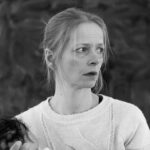
As an independent artist she created solo performances “Knife, Horse and Stairs.”, “Unfinished” and “Zanzibar”, and installation/performances “Still Alive” (2011) and “Food Cycle” (2011), ” Four corners” (2010), ” .No 1″ (2003), and several short animations “winter 2010”. In 2005 she was nominated to The Rolex Mentor and Protégé Arts Initiative. In the past she has worked extensively with Dance Theatre of Gdansk and Dada von Bzdülöw. She collaborated with Avi Kaiser, Tatiana Baganowa, Jerzy Mazzoll, Bronek Duży. With other three artist Jacek Staniszewski, Oskar Martin and Patrycja Kujawska she co-founded KLM’S Group and created “Te Takie Te”.
Aurora first came across VDT’s work when Charlotte was invited to Gdansk to workshop choreographic ideas as part of the Baltic University of Dance Winter Explosion festival. For VDT Aurora has performed in Caravan of Lies (1999), made and toured Drop Dead Gorgeous (2001), Let The Mountains Lead You To Love (2003), Punch Drunk (2004), Broken Chords (2005), Fairy Tale (2006), Look At Me Now, Mummy (2007), If We Go On (2009) and Motherland (2012-2014). Aurora lives in Poland.
Original soundtrack
Lighting Design by
Set Design
Videos


Photos
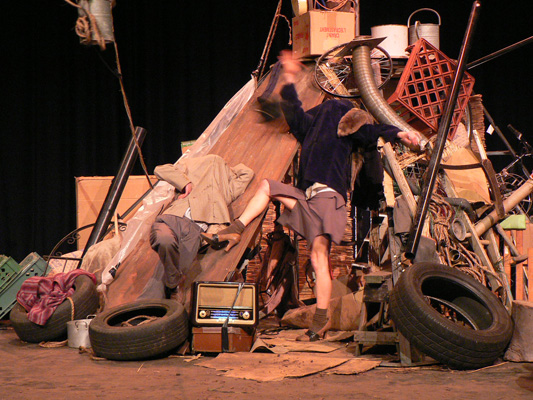
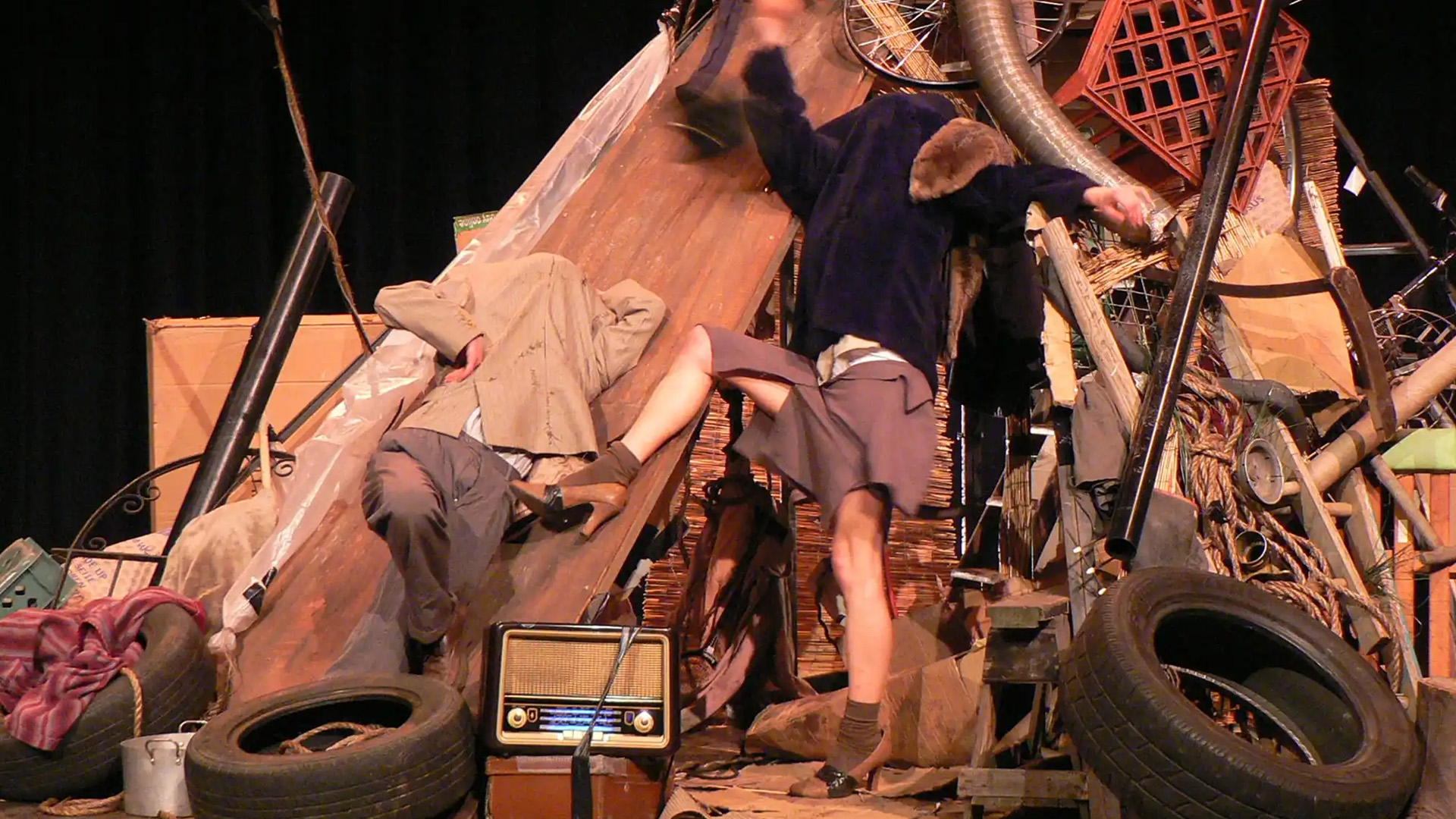
A chaotic pile of junk on stage with two people interacting energetically. The clutter includes tires, boxes, bicycles, and an old radio, evoking a sense of disorder.
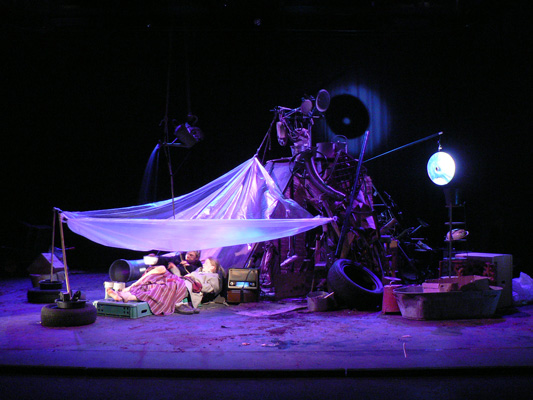
Dimly lit stage with a makeshift shelter of translucent fabric covers two people among scattered tires and debris, evoking a futuristic scrapyard vibe.
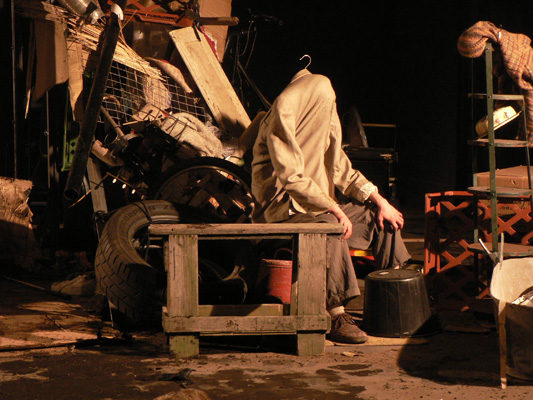
Alt text: A cluttered, dimly lit space with a figure draped in a coat sitting on a wooden bench. The setting is cluttered with various objects like tires, wood, and buckets, evoking a mysterious, sombre mood.
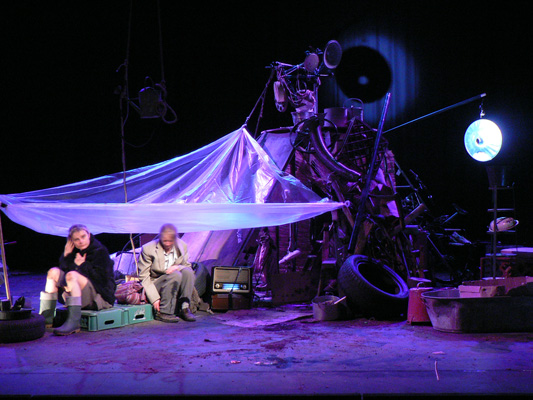
Two actors sit under a makeshift tent of translucent plastic amid a stage cluttered with tires and scrap. The scene is dimly lit, creating a sombre mood.
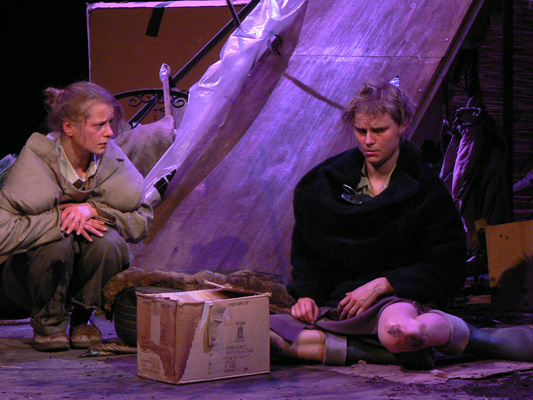
Two actors in a dimly lit theatrical scene convey tension. One person crouches, the other sits with a sombre expression. A cardboard box is nearby.
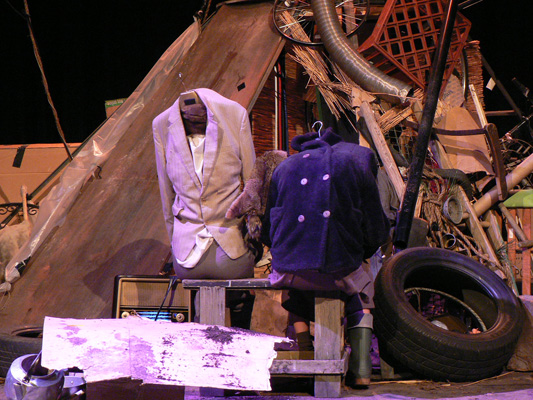
A dimly lit stage is cluttered with an eclectic mix of objects. Two headless mannequins, dressed in vintage coats, are positioned among old tires, metal pipes, a radio, and wooden scraps, creating a scene of organised chaos.
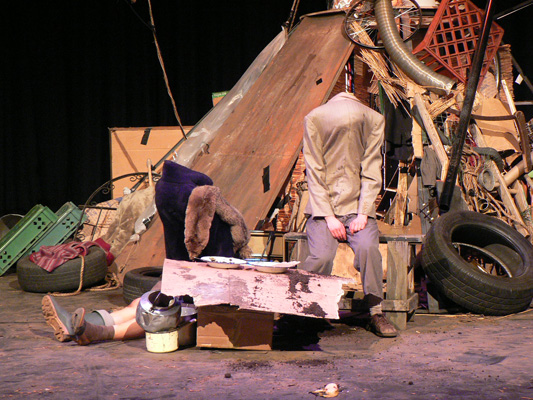
A chaotic stage set shows a pile of junk, including tires, cardboard, and a shopping cart. Two mannequins, headless and slumped, convey a sombre tone.
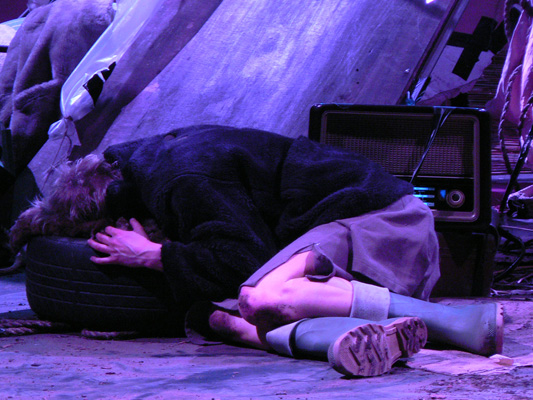
Person in dark clothing kneels and rests head on a tire amidst scattered debris. A pair of green boots lies nearby. Scene is dimly lit, evoking solitude.
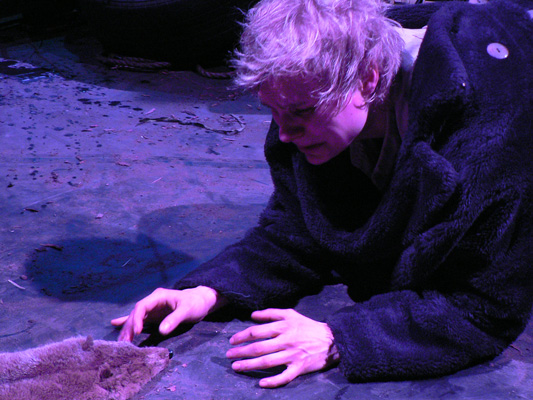
Person with short hair, wearing a dark coat, is kneeling on a dimly lit stage with a purple tint, reaching towards a patch of fur with a focused expression.
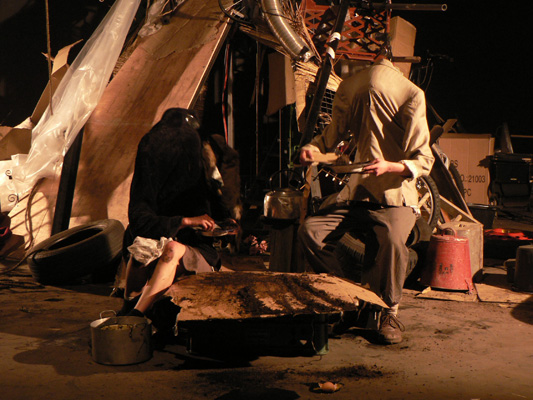
A headless figure in a suit holds pink flowers amid a cluttered scene of stacked tires, wooden items, and ladders, creating an eerie, surreal atmosphere.
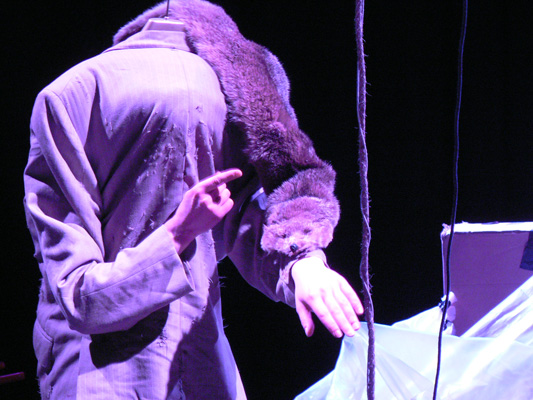
A person in a suit with a missing head illusion points at their wrist. A taxidermy animal is draped over their shoulders, in a dimly lit, surreal setting.
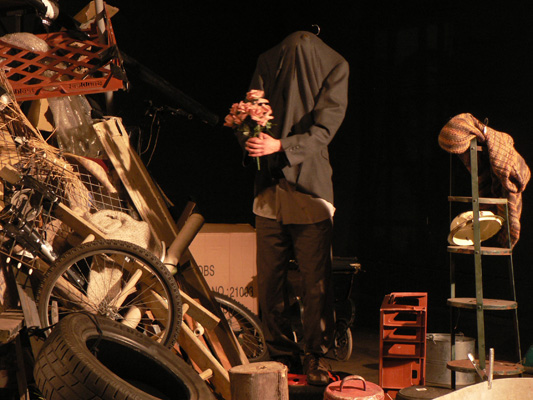
A headless figure in a suit holds pink flowers amid a cluttered scene of stacked tires, wooden items, and ladders, creating an eerie, surreal atmosphere.
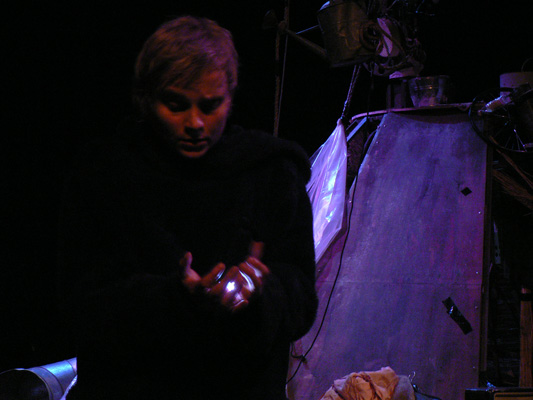
A person in dim lighting is centered, gazing at their glowing hands. A metallic structure with purple hues is behind them. The mood is mysterious.
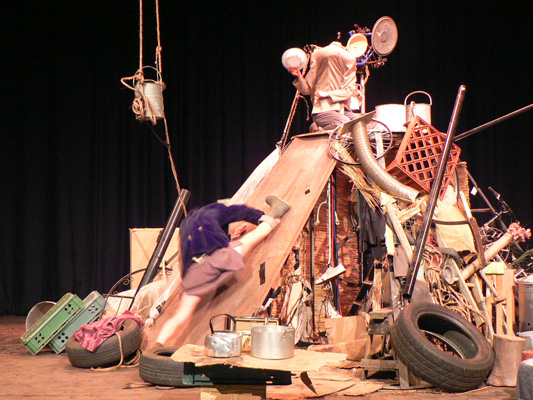
A performer climbs a slope made of junk, including tires, crates, and metal objects, against a black backdrop. The scene feels chaotic and industrious.
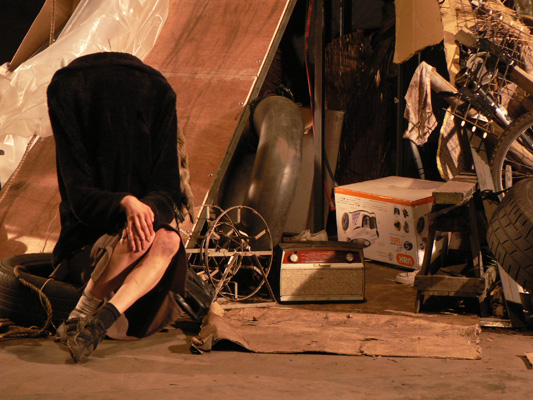
A person sits hunched in a dark coat, head hidden, in a cluttered space with scattered objects, including a vintage radio and a bicycle wheel, conveying isolation.
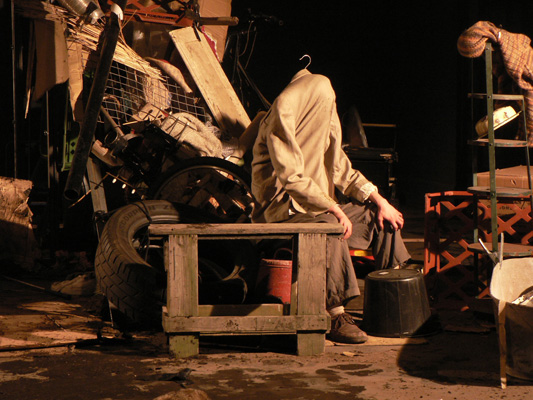
A figure with a coat over their head sits on a wooden bench among scattered items, including tires, crates, and pots, creating a sombre, chaotic scene.
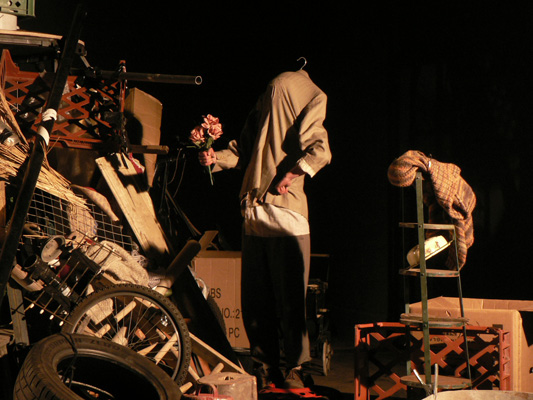
A headless mannequin with a shirt holds flowers in a cluttered space with tires, crates, and boxes. Dim lighting creates an eerie, surreal atmosphere.
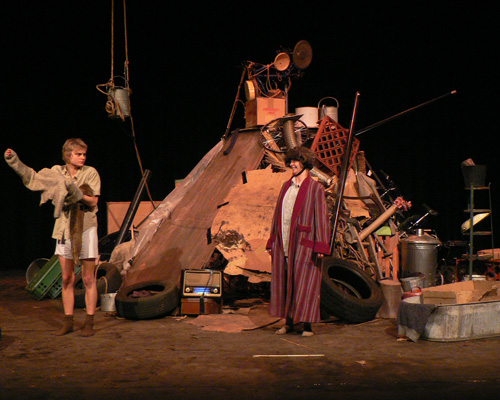
Two actors stand on stage amidst a chaotic pile of junk, evoking a sense of absurdity. One wears casual clothes, the other a long coat and hat.
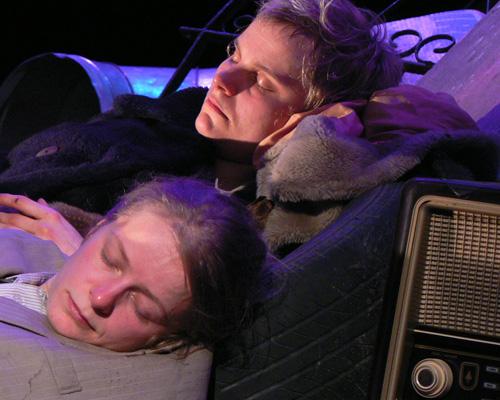
Two people are sleeping against one another, surrounded by various objects in a dim setting. Their expressions appear peaceful and tired. A vintage radio is visible in the foreground.
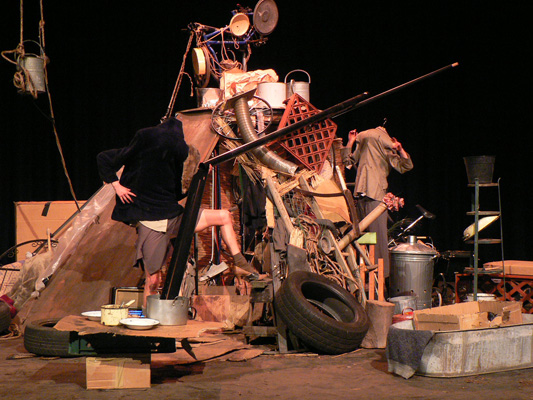
A cluttered stage set with piles of junk, including tires, metal scraps, and a bicycle. Two performers interact creatively, evoking a chaotic yet whimsical atmosphere.
Marketing
Some of the production’s original marketing materials are available for download here: