About
Double Vision was a collaboration by veteran anarchic performer Liz Aggiss and internationally acclaimed choreographer Charlotte Vincent.
Double Vision started with an empty space and a shared determination to make something together. Despite their differing aesthetic and physical practice, what binds these two performers is the search for a new language and something interesting to say.
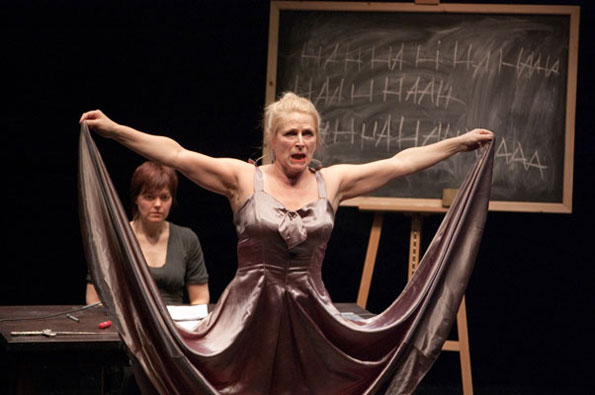
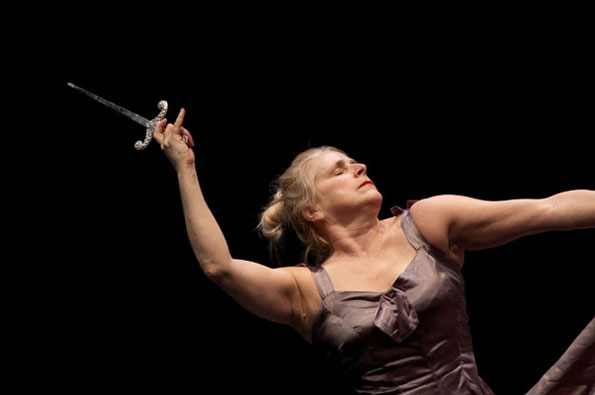
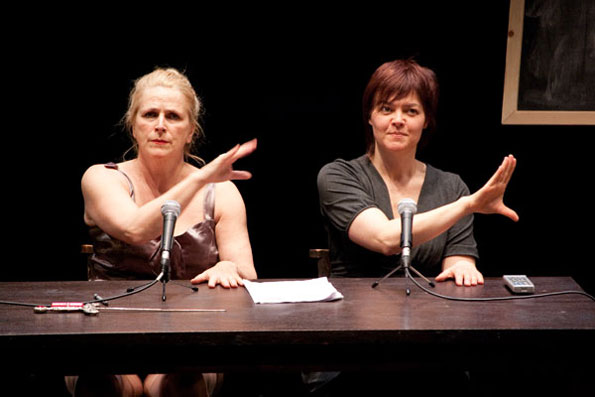
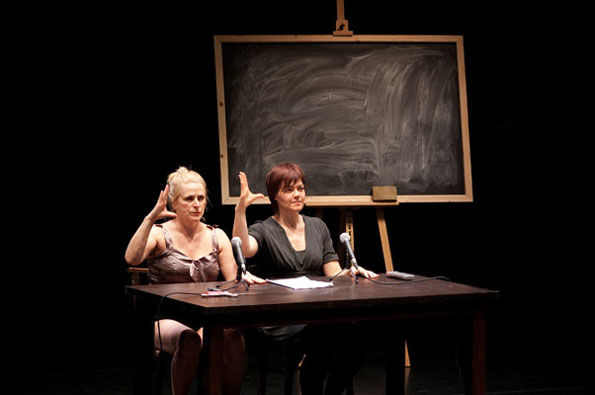
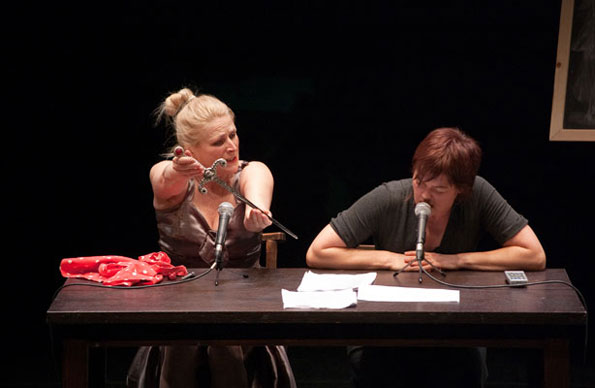
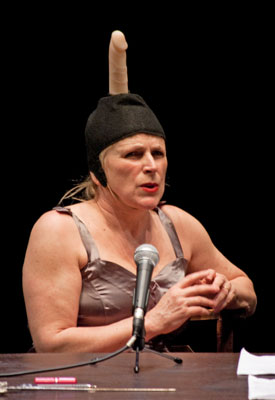
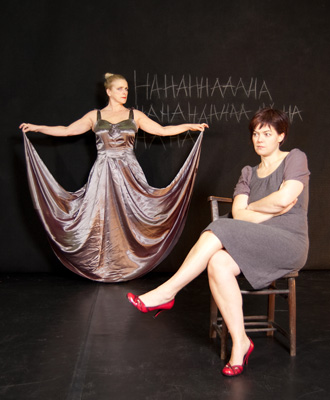
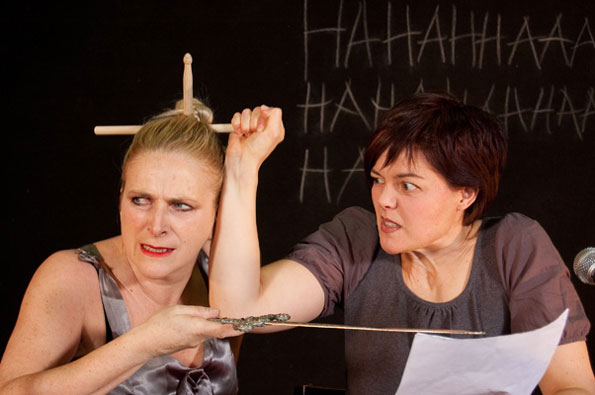
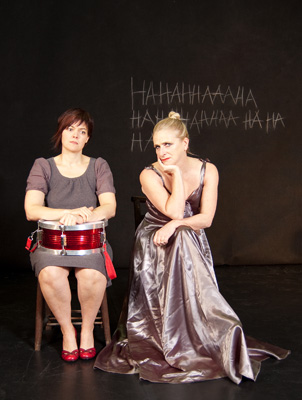
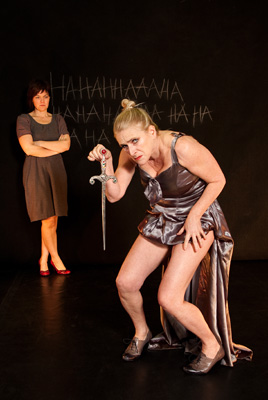
Working on equal terms and with a lightness of touch Liz and Charlotte explore unknown strategies to create a dance to be seen and heard. Basing dance vignettes around rhythmical structures found in the Queen of the Night Aria from Mozart’s opera The Magic Flute, the resulting work sits somewhere between live art and dance. A kind of female Morecombe and Wise doing a bit of self-penned Beckett.
Exposing the relationship between director and performer, between conceptual complexity and physical simplicity, between seriousness and humour, Double Vision is like nothing you will have seen before. A female double act with a combined age of 96, Double Vision sees two of the nations favourite dance creators trying to negotiate a language that neither of them usually speaks.
Double Vision toured with An Audience with Liz Aggiss and Charlotte Vincent, a provocative, unscripted conversation between the two looking at age, beauty, performance, creativity and humour, followed by an open discussion with the audience.
Liz Aggiss is a performer, choreographer, film-maker, writer, artiste and Professor of Visual Performance at the University of Brighton. Charlotte Vincent is Artistic Director of Vincent Dance Theatre.
Double Vision was their first collaborative project funded by Arts Council Englandand supported by the University of Brighton, The Basement, The Nightingale Theatre and Arnolfini Live.
ARTICLES
THE clue should come with the name, Vincent Dance Theatre, and surely everybody would agree that, in the world of dance, actions speak louder than words.
Yet here is Charlotte Vincent, the woman behind one of Sheffield’s most successful and enduring contemporary dance organisations, about to present not one but two new pieces in which the spoken word is at the centre of the work.
As if sensing that people might be surprised at this sudden and rather vocal turn, she insists: ‘I have always used text as a trigger in my work.”
‘Sometimes the text is hidden, sometimes there is a hidden language that only the dancers are following – and we have always talked a lot in our improvisation!’
And so we come to Double Vision and An Audience With Liz Aggiss and Charlotte Vincent, the new works coming to The Foundry at the University of Sheffield Students’ Union on April 1 in which Charlotte takes to the stage herself, alongside performer Liz Aggiss to create an evening of art, dance and discussion presented in the style of what the publicity material describes as ‘a kind of female Morecambe and Wise doing a bit of self-penned Beckett.’
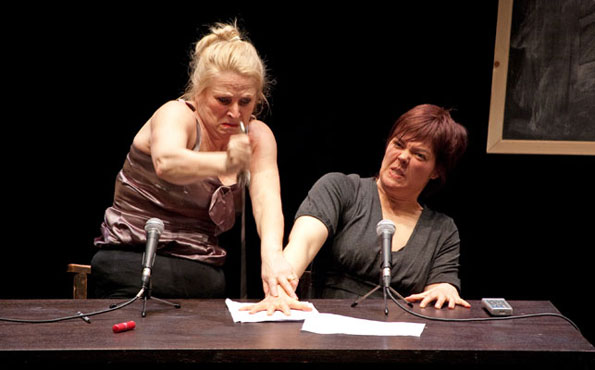
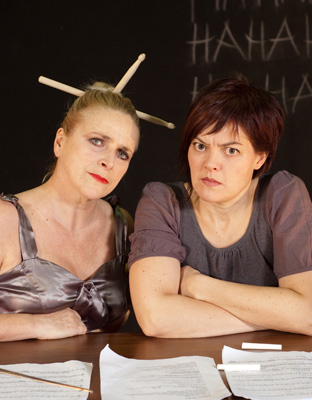
It might be hard to imagine the usually serious Charlotte Vincent as part of any sort of comedy double act but she agrees that this is very much what Double Vision, an exploration, among other things, of the relationship between director and performer, is about.
‘I’m basically the straight guy, the least manic of the two,’ she explains. ‘I’m like a school marm and I do behave like one in real life to be honest – it’s quite close to the bone perhaps.”
The pair met at a workshop and knew almost instantly that they would eventually want to work together. ‘We share the same sense of humour and for me that has been very interesting,’ Charlotte says. ‘I would say Liz is an anarchist and I think I’m a repressed anarchist, I’ve always been dutiful and developed things at a set rate but, of course, all double acts are about that tension.’
They were also, she adds two women at crossroads moments in their lives, looking for new challenges and out of that grew the piece that developed through a series of performances in Brighton and Bristol and now comes to Sheffield.
‘One of the themes running through it is that Liz doesn’t want to be told what to do and I can’t help it because I can’t let go of my directorial voice.”
‘It’s playing with that thin line between our real dynamic and our roles on stage and the comedy comes out of that.”
‘I am Liz’s foil, Liz is more flamboyant and I am the grounded one, the one that keeps trying to pull it back to being a little calmer.’
It sounds like the classic double act format – think of Ernie’s intellectual aspirations constantly undermined by Eric’s anarchic humour or Oliver’s pomposity thwarted by Stan’s childlike chaos – but then there’s also the more challenging element, the element that has been compared to Beckett.
‘It’s two women stuck in a performance place that they choose to keep going back to, they make considered choices about entering the place but when they are there they display patterns of behaviour that universal.”
‘What happens in this piece is structured and repetitive in a way that Beckett’s work returns to motifs and lines and structures.”
‘At the end of the day, it’s quite funny so even if people don’t get all this stuff will at least see Liz looking crazy and all the tension between us – and we know that works.
‘Double Vision also forced Charlotte to leave the security of being a choreographer and become a performer again.
And she sounds almost surprised as she admits: ‘I’m enjoying the performance though I suppose the directorial role I am playing in the show is an extension of what I do in my everyday life.’
It’s back to direction though for Straight Talking, one of the four pieces that make up Bare Bones 6, the evening of dance that comes to Sheffield’s City Hall Ballroom on April 6.
And now that she has found a voice, it seems like Charlotte wants to make the most of it as she has dancer Robert Clark expressing himself not through movement alone but also with words.
‘It’s basically a rebellion by Robert against the rest of the programme and against dance itself really,’ Charlotte says. ‘It’s anti-dance.”
‘It’s like he breaks away from the rest of the company but then finds it doesn’t go quite according to plan.”
‘I suppose he’s asking what is movement about, where does it come from and what happens if you don’t want to dance any more? It exposes the effort it takes to move.’
Maybe there’s just an element of how Charlotte feels herself what Robert goes through in Straight Talking.
‘I’m 41 now and I’ve seen a lot of new things that are celebrated but which I find myself thinking are not much different to the things that were new ten years ago,’ she says, which is perhaps why in 2009 she is experimenting with new ways of expression and embracing the idea that words can mean as much as movement.
‘I know I can make people laugh and I know I can make people cry,’ she says. ‘Now it’s more about pushing the aesthetic and the form – I’m not interested in line, I’m interested in humanity.’
“What I was doing in my twenties I thought was great but I am 20 years older now and I don’t want to be doing the same things.’
Anarchic dancer and artist Liz Aggiss’ brand of performance has never been easy to shoehorn into any specific category, and her latest show continues to evade easy definition.
A collaboration with Charlotte Vincent of the acclaimed Vincent Dance Theatre, Double Vision blends dance and dialogue in an opening piece before its creators present a scripted conversation with each other to the audience.
Finally, there will be a question and answer session with Vincent and Aggiss, who first met on an artists’ retreat in Scotland.
“We’ve created this piece of work which is really like a comic double act,” Aggiss says.
“We were interested in what it’s like to be mature artists – I’m quite decrepit now, and we have a combined age of 96. Dance is normally thought of as something for the youthful nymphette, but I still hop around like a spring chicken, so that was another area we thought we could incorporate into the work.”
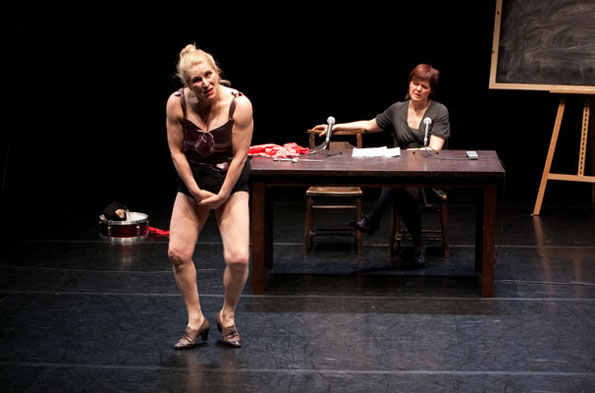
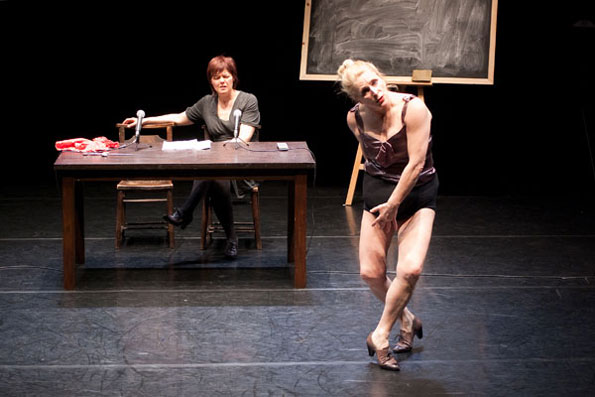
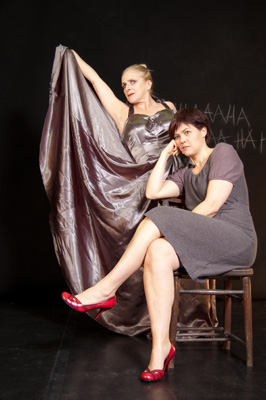
The piece also seeks to explore the often fraught relationship between director and performer, and sees both of them play up to the roles they occupy outside of the collaboration, as Aggiss – very much a performer – demonstrates a series of dance pieces or “acts” to Vincent.
“It does present quite a tussle,” Aggiss says. “It’s a very odd situation, because I’m used to directing myself and performing and Charlotte has been in the role of director and hasn’t performed for some years.”
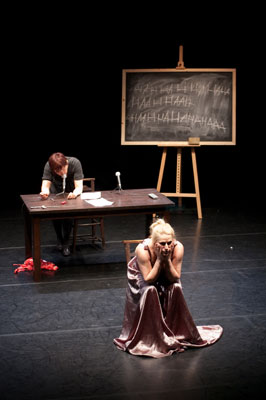
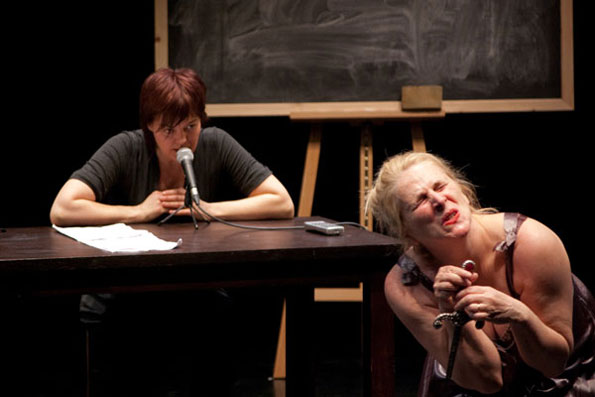
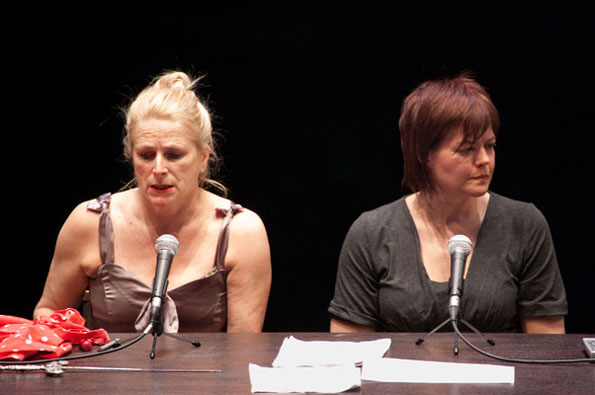
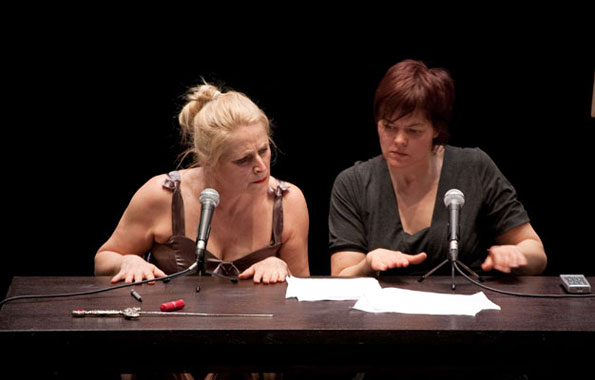
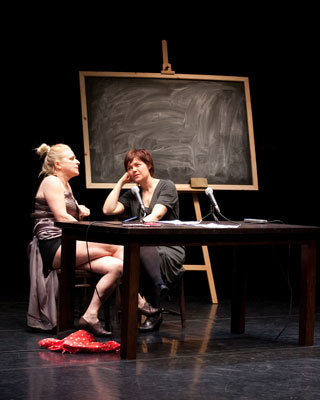
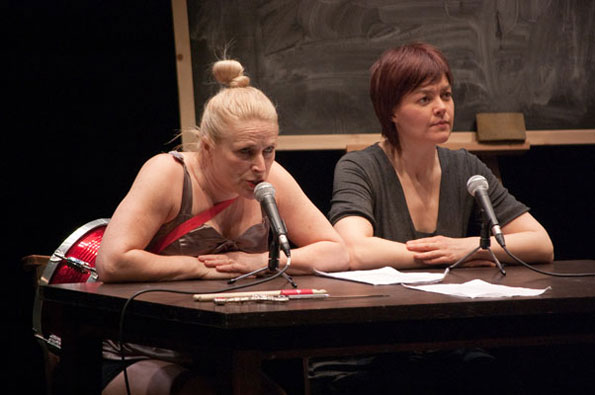
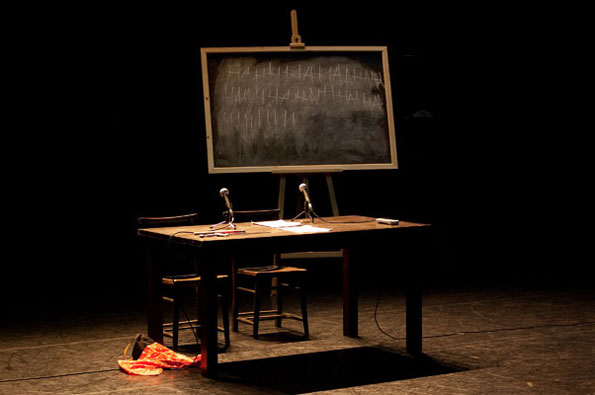
Aggiss and Vincent utilise a space containing a table and chairs with a series of microphones. Sometimes they perform into the microphones and sometimes deliberately off-mic. There are also clearly demarcated on-stage and off-stage performance areas that they inhabit.
“The audience is very clear when we’re off and when we’re on-stage and kind of collude with the audience to explain what we’re doing,” Aggiss explains.
This liminal approach has characterised Aggiss’ work.
As well as being a dancer, she is also a film-maker, artist and professor of visual performance at the University of Brighton.
“All disciplines are up for grabs for me,” she says. “I enjoy moving between disciplines, but it’s strange when people ask me what I do – I just say ‘I’m Liz Aggiss’.”
Double Vision will continue to tour for the rest of the year, before Aggiss takes up another film project.
“I have a commission from South East Dance to make a new screen-dance film, so I’ll be shooting, directing and choreographing that around July and August. It’s called Party Animal and it’s about looking at the animalistic qualities of human beings.”
Credits
Devised and Performed by
Charlotte Vincent
Artistic Director & Chief Executive (She/Her)
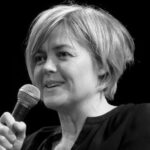
Charlotte formed Vincent Dance Theatre (VDT) in 1994 and has directed all the company’s collaborative work to date, on stage and on film. Vincent has also designed the work since 2005 and performed with the company until 2002. Vincent’s distinctive, contemporary choreography ‘stages ideas’ and embeds her own and her collaborators’ lived experience within the work, raising awareness of personal and political issues, breaking down the barriers between professional and non-professional performers and in VDT’s film installation and engagement spaces, between audience and participant.
Vincent is recognised as a sector leader in movement based socially engaged creative practice and creative health, particularly around her work with care-experienced young people and women at risk, championing gender equality and advocating for best practice to support parents and carers working in the performing arts. Her pioneering work on film ensired VDT were ‘covid ready and able to work through Covid and consequently allows Vincent’s work to be purposefully ‘applied’ in non-arts settings as well within conventional arts venues and settings.
Charlotte is an experienced speaker, lecturer and Mentor, working with early and mid-career artists to develop their creative practice and production work. Vincent has also worked as a director, dramaturg, and facilitator for other artists and companies, most notably Two Destination Language (Near Gone, winner Total Theatre Awards for Innovation and Experimentation 2014), Keira Martin (Here Comes Trouble Sadlers Wells Wild Card and Good Blood) and facilitating early R&D for Sue MacLaine’s Can I Start Again Please (2013).
In the past, Vincent has performed and collaborated with Professor Liz Aggiss as V&A Artefacts, curated an inaugural 4-week festival of experimental performance practice, Juncture at Yorkshire Dance in Leeds and co-hosted The Table, a forum to nurture dialogue across disciplines between established female artists with Dr Claire Macdonald. Charlotte sat on the Artists Advisory Group at Yorkshire Dance for several years and Steering Group for Dance UK’s National Choreographic Conference in 2013. Most recently she has been a driving force behind the development of the London Road Network in Brighton, a collaborative group of organisations and individuals working towards deeper interaction between arts orgs and grassroots organisations in one of Brighton’s more deprived areas.
Vincent is Safeguarding Lead for VDT, trained in Trauma Informed Practice, Mental Health First Aid, therapeutic parenting, and First Aid. She completed a Clore Leadership Short Course (2010), the Clore Programme for CEO/Artistic Directors (2011) and Clore Brave Conversations Programme (2013). Vincent is also trained in FA Football Coaching.
Vincent has written chapters and been written about in several Routledge Publications (resources) and PhD’s, and her work Art of Attachment lies at the heart of Dr Cath Lambert‘s imminent publication Troubling Adoption.
In 2023, Dr Vincent gained a PhD in Performing Arts from Canterbury Christ Church University, reflecting on VDT’s socially engaged practice, supervised by Professor Angela Pickard, Director of the Sidney de Haan Centre for Arts and Health.
Dr Charlotte Vincent lives in Brighton with her son, who loves mountain biking, fishing and gaming.
Videos

Explore this production

Photos
Double Vision
Double Vision
Double Vision
Double Vision
Double Vision
Double Vision
Double Vision
Double Vision
Double Vision
Double Vision
Double Vision
Double Vision
Double Vision
Double Vision
Double Vision
Double Vision
Double Vision
Double Vision
Double Vision
Double Vision
Double Vision
Double Vision
Press
“Immaculate timing and choreographic precision we expect (and get) from these two highly experienced dance artists... Enterprising entertainment. Brave ladies! Take a bow, do!”Dorothy Max Prior, Total Theatre, Vol 21, Issue 02, Summer 2009